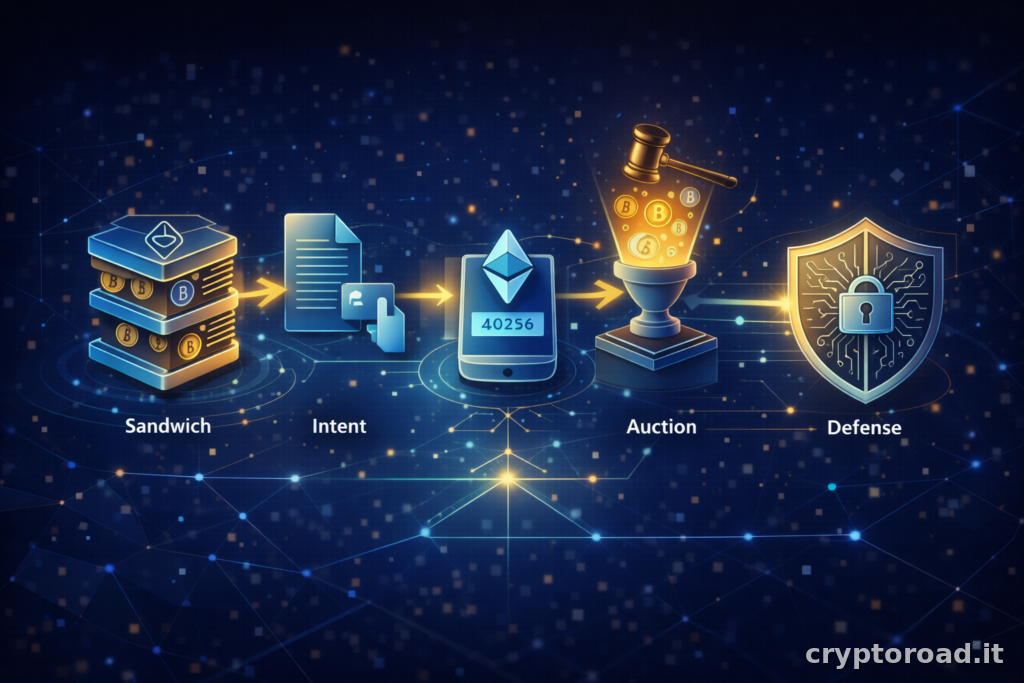
Educational content: does not constitute personalized financial, legal, or tax advice.
MEV is not a marginal phenomenon; it is a structural component of on-chain markets. Understanding its dynamics and defenses helps reduce implicit costs and execution risk, especially on DEXs and automated strategies.
Key takeaways
- MEV includes both legitimate value extraction and harmful practices.
- Sandwich attacks remain relevant, but the market is evolving toward intent/auction models.
- Routing quality directly impacts the final user cost.
- Practical defenses exist and should be applied by default.
What is MEV and why it matters
MEV is the value capturable through the ordering, inclusion, or exclusion of transactions. In highly competitive ecosystems, this value shapes infrastructure and incentives.
For the end user, this translates to extra slippage, worse executions, or, in the best cases, more efficient matching mechanisms.
Sandwich attacks: mechanics and impact
In a sandwich attack, an actor front-runs and follows a victim’s transaction to capture price differentials. Damage increases with thin pools, large orders, and high slippage tolerance.
Understanding this dynamic is the first step toward defense.
Intents and auctions: design evolution
Models based on intents and auctions aim to shift competition into more controlled environments where the best price for the user is an explicit goal.
They do not eliminate all risk, but they can reduce negative externalities compared to a pure public mempool.
Practical defenses for users and teams
Use aggregators with MEV protection, set prudent slippage limits, fragment large orders, and prefer high-liquidity windows.
For DeFi teams: pre-trade simulations, monitoring of execution quality, and fallback routing in case of degradation.
Operational metrics to monitor
Execution price vs. mid-price, fill rate, transaction failures, slippage variation by time-of-day, and the incidence of suspicious transactions.
A single isolated metric can be misleading; historical series and benchmarks are essential.
Conclusion
In 2026, the challenge is not to “avoid MEV” absolutely, but to minimize harmful MEV and maximize execution quality for users and protocols.
Mistakes to avoid
- Making decisions based on a single source or a single metric.
- Increasing exposure without a written exit plan and maximum risk limit.
- Confusing operational speed with execution quality.
Quick checklist
- Define your objective and risk limit before acting.
- Verify data, context, and critical dependencies.
- Start small, measure, then scale.
- Document decisions and outcomes to improve the process.
FAQ
Is MEV always malicious?
No, it depends on the mechanism and incentives.
Is low slippage enough to protect yourself?
It helps, but it is not sufficient on its own.
What is the first defense to adopt?
MEV-protected routing with clear operational limits.
Methodology and sources
For deeper insights, use official documentation from involved protocols/entities, technical reports, replicable on-chain data, and analyses with explicit methodologies. Avoid summaries without verifiable sources.
Operational approach: from theory to practice
To turn MEV, sandwich attacks, intents, and auctions into actionable decisions, a repeatable process is needed. The first step is defining the context: objective, time horizon, risk constraints, and the indicators you will use to evaluate whether the thesis is working or not. Without this perimeter, even good data gets interpreted inconsistently.
The second step is setting invalidation thresholds before acting: what must happen to reduce exposure, suspend operations, or revise the strategy. Predefined thresholds reduce impulsive errors and improve execution quality when the market accelerates.
Practical cases and trade-offs
Every choice involves compromises. In the context of MEV, sandwich attacks, intents, and auctions, the fastest solution does not always coincide with the most robust one: reducing complexity can increase control, but sometimes limits flexibility. The goal is not to maximize a single metric, but to find a sustainable balance between efficiency, security, and liquidity.
For this reason, it is useful to simulate two opposite scenarios: a base case and a stress case. In the first, you measure ordinary operational costs; in the second, you evaluate response times, execution quality, and the ability to contain damage. If the model fails under stress, it must be corrected before scaling up.
5-step decision framework
- Define the problem in one clear, verifiable sentence.
- Gather minimal reliable data, avoiding information overload.
- Evaluate alternatives with pros/cons and the maximum risk you can tolerate.
- Run a controlled test with reduced exposure.
- Review the result and update operational rules and
Related reading: Bitcoin Market Cycles: The Complete Guide to Every Phase · On-chain analysis: a guide to understanding the crypto market.