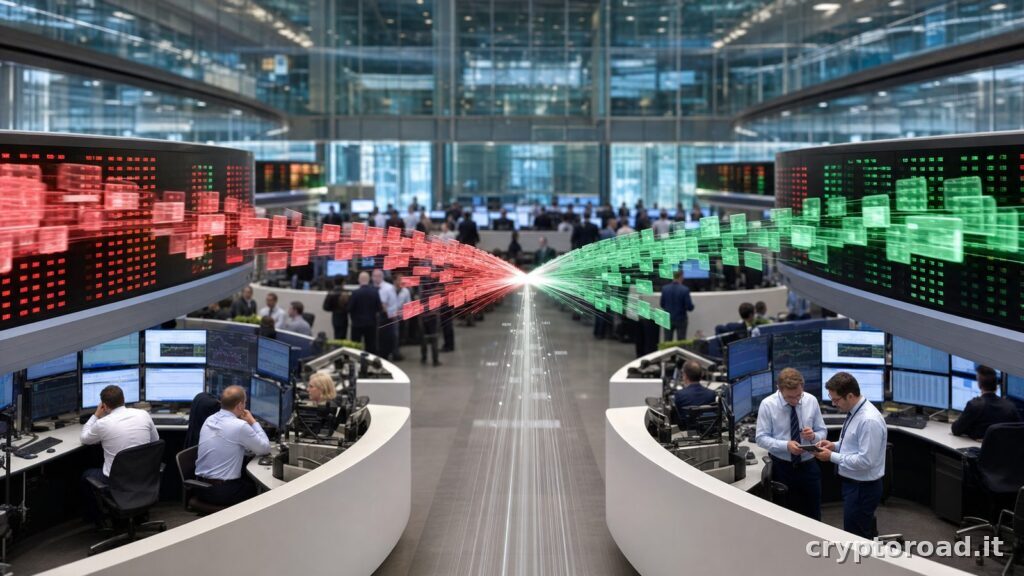
Understanding how the stock market works means looking past the flashing price and following an order from the investor to its final execution. A stock may be listed on one exchange, yet a broker can route an order to another exchange, a market maker or a different trading venue. The displayed quote is therefore only the visible edge of a wider execution system.
This guide explains that system in operational terms: who buys and sells, how bids and offers form, why orders fill only partly, and where explicit and hidden trading costs arise. It complements our broader guide to what stocks are and what shareholders actually own. Execution matters, but it is only one layer of an investment decision.
How the stock market works from listing to execution
A listing gives a company’s shares an official home market, ticker and set of disclosure obligations. It does not mean every trade must take place on that exchange. In modern markets, the same listed stock can be executed across several registered exchanges and off-exchange venues. FINRA’s overview of where stocks trade describes this fragmented structure and the role of alternative trading systems, broker-dealers and internalizers.
An investor normally reaches those venues through a broker. After receiving an order, the broker selects a destination according to its routing arrangements, available prices, order size, speed, likelihood of execution and other factors. The US Securities and Exchange Commission’s investor guide on executing an order notes that execution is not instantaneous and that the price seen when an order is entered may differ from the final price.
Best execution is the broker’s duty to seek the most favorable reasonably available terms under the circumstances. It is not a promise that every order will receive the day’s best possible print. A routing decision may balance price improvement, speed, fill probability and total transaction size. Brokers may also receive payments or other economic benefits from particular venues, which makes their routing disclosures worth reading.
| Market element | Operational role | Main risk to watch |
|---|---|---|
| Listing exchange | Primary admission, ticker and issuer rules | Confusing the listing with the execution venue |
| Broker | Receives, routes and supervises the order | Routing quality and conflicts |
| Trading venue | Matches orders or supplies liquidity | Price, speed and fill probability |
| Order book | Displays available buying and selling interest | Shallow depth beyond the best quote |
| Investor order | Defines quantity and execution constraints | Using the wrong order type |
Buyers, sellers, bid, ask and spread
Every completed trade requires a buyer and a seller, but they do not need identical motives or time horizons. A pension fund may rebalance, a market maker may manage inventory, an index fund may follow a benchmark, and an individual may change a position. The market matches compatible instructions without deciding which participant has the better thesis.
The bid is the highest displayed price a buyer currently offers. The ask, also called the offer, is the lowest displayed price a seller currently accepts. Investor.gov defines the ask price as the price at which a security is offered for sale. The difference between the best ask and best bid is the bid-ask spread.
If a stock shows a bid of $49.98 and an ask of $50.02, the quoted spread is $0.04. A market buyer will generally interact with available sellers near the ask; a market seller will generally interact with buyers near the bid. Crossing the spread is an implicit cost, even when the broker advertises zero commission.
Depth matters beyond the best quote
The top quote reveals only the first price level. The order book may show 200 shares offered at $50.02, another 500 at $50.05 and 1,000 at $50.10. A buy order larger than the first level can consume several offers, producing an average execution price above the initial ask.
Depth is not permanent. Participants can add, cancel or modify orders as information and market conditions change. A book that looks deep in a quiet period may thin abruptly around earnings, economic data or a broad sell-off. Displayed liquidity is useful evidence, not a contractual guarantee of future fills.
Market, limit and stop orders
An order type tells the broker and venue what trade-off the investor accepts. FINRA’s guide to stock order types distinguishes instructions by their price conditions and activation rules. The right choice depends on whether certainty of execution or control of price has priority.
A market order seeks prompt execution at the best prices then available. It controls neither the final price nor the average price across multiple fills. In a highly liquid stock and modest size, the result may be close to the quote. In a fast or shallow market, the difference can be meaningful.
A limit order sets the worst acceptable price: the maximum for a purchase or the minimum for a sale. The SEC’s explanation of limit orders emphasizes the central trade-off: price protection comes with no guarantee of execution. A buy limit at $50 cannot execute above $50, but it may remain unfilled if sellers never reach that level.
A stop order remains inactive until its trigger price is reached. It then commonly becomes a market order, so the trigger is not a guaranteed execution price. A stop-limit order becomes a limit order instead; it controls the acceptable price but can fail to execute during a rapid move. Those distinctions become critical when prices gap between trades.
A numerical example with Company Alfa
Assume fictional Company Alfa is quoted at $24.96 bid for 300 shares and $25.00 ask for 200 shares. The next sell levels contain 400 shares at $25.04 and 700 at $25.10. An investor submits a market order to buy 800 shares.
If the displayed book remains available, 200 shares fill at $25.00, 400 at $25.04 and 200 at $25.10. The total is $20,036, giving a volume-weighted average price of $25.045 per share. Relative to the initial $25.00 ask, the buyer pays $36 more because the order walks through several price levels. That is a simple illustration of market impact and slippage.
Now replace the instruction with a buy limit of $25.04. Up to 600 shares can execute at or below the limit, while the remaining 200 stay open or are canceled according to the time condition. This is a partial fill: the investor receives price protection but not the requested full quantity.
If other buy orders were already resting at $25.04, the new order generally joins behind them. Markets usually apply price priority first and time priority among orders at the same price, although detailed matching rules can differ. Moving the limit to a more aggressive price may improve execution probability, but it also accepts a higher purchase price.
Price discovery, liquidity and volume
Price discovery is the continuing process through which competing orders incorporate public information, expectations, risk tolerance and urgency. A new earnings report may make buyers raise bids, sellers withdraw offers or both. The next trade is not an official verdict on value; it is the price at which available participants agree for a particular quantity at that moment.
Volume measures how many shares trade during a period. Liquidity describes how readily a position can be bought or sold near prevailing prices without causing a large price change. High volume often supports liquidity, but the terms are not interchangeable. A volatile news session can generate enormous volume while spreads widen and depth disappears.
Useful liquidity signals include the spread, displayed depth, average trade size, turnover and the stability of quotes under pressure. None works alone. A narrow spread for 100 shares says little about the likely cost of executing 50,000 shares.
Slippage is the difference between an expected reference price and the actual execution. It can result from latency, fast-moving quotes, insufficient depth or the order’s own impact. Positive price improvement is also possible when execution occurs at a better price than the displayed quote. Evaluation should therefore use the full set of fills, not a screenshot taken before submission.
Auctions, interruptions and trading outside regular hours
Continuous trading is only part of the session. Opening and closing auctions collect orders and calculate a single price designed to execute the greatest compatible quantity under the venue’s rules. The open absorbs information accumulated overnight; the close is especially important for funds measured against official closing prices and for index rebalances.
Volatility controls can pause a stock or constrain trading when moves exceed defined thresholds. A pause creates time for information and orders to accumulate, but it does not guarantee a calmer reopening. The restart may use an auction, and a large gap can occur if buying and selling interest remains unbalanced.
Pre-market and after-hours sessions commonly have fewer participants, thinner depth, wider spreads and more fragmented quotes. Some brokers accept only limit orders in those periods. Prices may react strongly to news and may not predict the next regular-session opening. Investors should verify session settings rather than assume an ordinary order will be handled identically around the clock.
Commissions are only one part of execution cost
A commission is explicit: it appears as a charge for the transaction. Regulatory, exchange, currency-conversion or account fees may also apply. A zero-commission label does not make an execution free because the spread, slippage, market impact and opportunity cost of an unfilled order remain economically real.
Suppose two brokers charge no commission. One fills a purchase at an average of $40.01 while another fills the same order under comparable conditions at $40.06. On 1,000 shares, the five-cent difference is $50. Execution quality can therefore matter more than the visible fee, although a single trade is not enough to judge a broker systematically.
Order confirmations reveal timestamps, venues, partial fills and average prices. Our guide to a trading and investing journal shows how written rules can expose repeated execution errors without confusing activity with progress.
Common execution mistakes
Treating the last price as a guaranteed quote
The last trade is historical. It may have occurred seconds earlier, for a tiny quantity or on another venue. An executable decision should consider the current bid, ask, size and book conditions.
Using a market order in a thin book
Urgency can be expensive when little quantity is available near the top quote. The order may sweep several levels before the trader sees the confirmation.
Setting a limit without considering the queue
A limit equal to the best bid does not ensure a fill. Existing orders at that price may have priority, and the market can move away before the queue reaches the new instruction.
Assuming a stop guarantees the trigger price
A standard stop controls activation, not execution price. A gap can produce a fill well beyond the stop, while a stop-limit can remain unfilled entirely.
Ignoring session and corporate-event details
Extended-hours settings, auction cutoffs, trading halts, splits and dividend adjustments can change how an order behaves. Stale good-till-canceled instructions deserve review before known events.
Execution quality cannot rescue a weak investment thesis
Knowing how the stock market works can reduce avoidable friction, but a precise limit price does not turn an overvalued, fragile or misunderstood company into a sound holding. Execution answers how a position is entered or exited. The investment thesis addresses what is owned, why its future cash flows or strategic position may matter, what could invalidate the case and whether the price offers an adequate margin for uncertainty.
This distinction connects execution to the wider stock pillar. Company analysis, valuation, diversification and time horizon sit upstream of order placement. A spectacular market move—such as the event discussed in our report on BitMine, crypto accumulation and a soaring stock price—may attract attention, but price action alone does not establish business quality or durable value.
The reverse is also true: a well-researched thesis can be damaged by careless execution when the spread is wide, the position is large or liquidity is temporary. Thesis quality and order quality are separate controls. Both matter, and neither substitutes for the other.
Practical order checklist
- Confirm the ticker, share class, currency and intended trading session.
- Check the live bid, ask, spread and displayed quantities, not only the last price.
- Compare the order size with available depth at several price levels.
- Choose whether execution certainty or price protection has priority.
- Understand exactly when a stop activates and what order it becomes.
- Set an appropriate time condition and review any auction cutoff.
- Expect partial fills and decide beforehand how to handle the remainder.
- Consider commissions, fees, spread, slippage and potential market impact together.
- Review the confirmation, venue, timestamps, individual fills and average price.
- Recheck the investment thesis independently from the quality of the execution.
In practical terms, how the stock market works is a chain of instructions, routing choices, queues and matching rules. The investor controls the order’s constraints, not the market’s response. Reading the quote as a live set of available quantities—and separating execution discipline from investment conviction—leads to a more accurate view of what happens after the buy or sell button is pressed.