Educational guide: does not constitute financial advice. Updated February 2026.
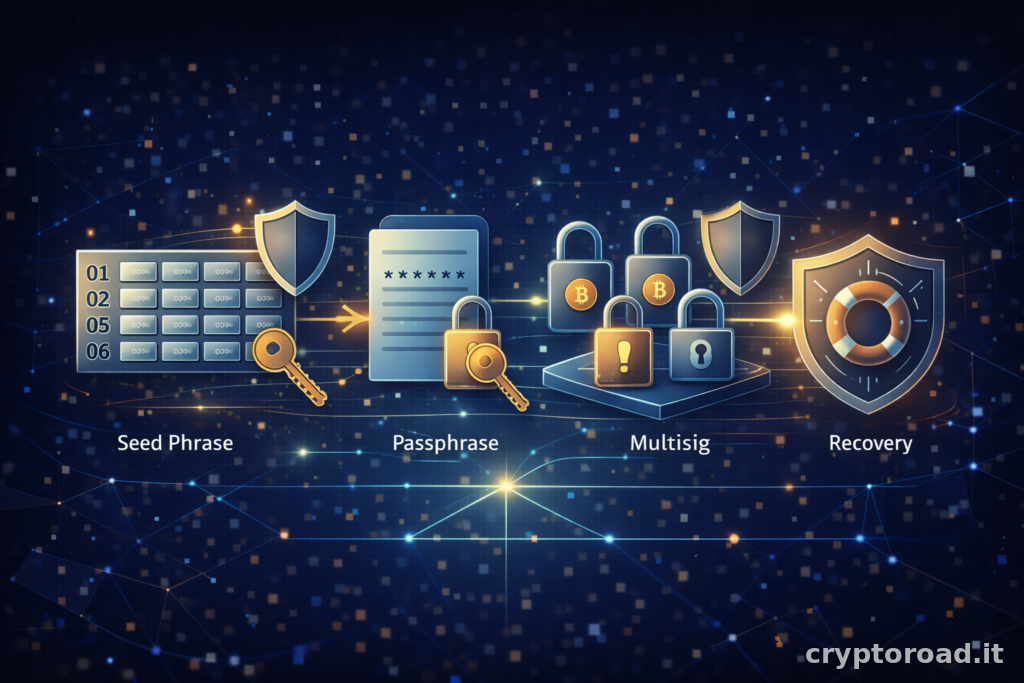
Self-custody promises direct control of assets, but methodless control increases risk instead of reducing it. In this guide on self-custody wallet find a practical and verifiable method to protect capital and operations. In this guide we see in a practical way how to set up a robust personal custody strategy: seed phrase, passphrase, multisig, recovery plans and anti-error procedures. The goal is not to make “more theoretical security”, but to build a system that holds up over time even when you are under pressure.
If your crypto assets grow, the main risk is not just the market: it is operational fragility. Lost passwords, incomplete backups, wallet confusion, compromised devices and untested processes are recurring causes of loss. A good custodial architecture reduces these weaknesses with simple, documented and repeatable rules.
What to know right away (in 60 seconds)
- The seed phrase is the main control point: whoever owns it controls the funds.
- The passphrase adds protection, but increases complexity: it should only be used with a tested recovery plan.
- Multisig reduces the risk of single point of failure, but requires governance and procedures.
- The backup is not a hidden sheet: it is a system of preservation, verification and updating.
- True safety is operational: checklist, periodic tests, separation of roles and emergency plan.
Because self custody does not mean automatic security
Many users switch to self-custody thinking that it is enough to “not leave the funds on the exchange” to be safe. It’s an important improvement, but not enough. In self-custody you go from counterparty risk to personal operational risk: any management error falls entirely on you.
The difference between resilient users and fragile users is not the brand of the wallet. It’s the quality of the process: how you generate keys, where you keep backups, how you secure devices, how you manage updates, and how you react in the event of an incident. Without process, technology becomes just a false sense of control.
For this reason, it is best to set up the custody as a small system with levels: operational wallet for daily use, reserve wallet for medium term, long-term storage with stricter rules. Each level has different objectives, limits and procedures.
Seed phrase: fundamentals, typical errors and correct protocol
The seed phrase (usually 12 or 24 words) is the cryptographic root from which private keys and addresses are derived. It is not a password to be memorized “in mind and go”, but a structural secret that requires professional management, even for personal assets.
Typical errors: photo of the seed on the phone, seed saved in the cloud, seed shared in chat “temporarily”, single copy in a fragile place, lack of real verification of the backup. They are high-risk practices because they expand the attack surface or introduce single points of failure.
Recommended protocol: offline generation on a trusted device, readable manual transcription, word-for-word double verification, storage in two separate and protected physical copies, periodic check of the integrity of the medium. The protocol must be written and replicable, not improvised.
A useful rule: think of the seed as a safe key with full access. Don’t ask yourself “where do I hide it?”, ask yourself “how do I guarantee availability, confidentiality and recovery in 1, 3 and 10 years?”.
Passphrase: when to use it and when to avoid it
The passphrase (often called the “25th word”) adds a separate layer to the seed. In practice, it creates a different wallet starting from the same seed. It’s powerful because it reduces the risk that a compromised seed will immediately lead to access to real funds, but greatly increases the risk of user error.
If you use passphrases without solid procedures, you can exclude yourself from funds. The most common mistake is having a passphrase “remembered” but not securely documented, or inconsistent variations (capitalization, spaces, symbols) that make recovery impossible years later.
When it makes sense: significant assets, disciplined user, mature backup process, periodic recovery tests. When to avoid it: initial phase, occasional operation, absence of a documented plan. The passphrase is not mandatory for everyone; it is an advanced tool.
If you adopt it, immediately define: format, storage location, redundancy strategy and verification procedure. Without these four elements, it is better not to use it.
Multisig: real benefits, operational costs and thresholds
Multisig requires multiple keys to authorize a transaction (e.g. 2-of-3 or 3-of-5). Reduces risk of single compromise: if one key is lost or exposed, it is not enough to move funds. It is very effective for family treasuries, small teams and large estates.
But multisig is not free in operational terms. Increases complexity of setup, coordination and recovery. If signatories do not have common procedures, theoretical security can turn into an operational block at critical moments.
Practical choice of thresholds: 2-out-of-3 often balances resilience and usability; 3-out-5 improves redundancy but requires more governance. The right threshold depends on frequency of use, geographic distribution of signatories, required speed, and acceptable level of risk.
Before adopting it, perform a complete simulation: wallet creation, test transaction signature, simulated loss of a key, recovery, signer replacement. If the team does not complete the simulation, the multisig is not ready for real funds.
Recovery planning: the piece that almost everyone underestimates
Recovery means being able to return to work after an adverse event: device theft, loss of support, temporary unavailability of the signatory, physical accident, account compromise. A serious plan includes roles, priorities, timeframes and tools.
Minimum plan structure: wallet inventory and purposes, dependency map (seed, passphrase, hardware, 2FA, email), emergency procedure in chronological order, necessary contacts, post-incident checklist. All in one updated and understandable document.
The periodic test is mandatory: it is not enough to “have the plan”. Every 3-6 months it is advisable to simulate at least one real case with a stopwatch: how long does it take to restore secure access? Where do bottlenecks emerge? Which steps are unclear?
A recovery plan doesn’t just reduce technical damage. It reduces decisional panic, which is a major loss multiplier in times of stress.
Recommended single-user architecture (practical)
A realistic configuration for an advanced user could be: hot wallet with low limit for daily operations, warm wallet for tactical reserves, cold wallet for strategic assets. Each layer has maximum budget and transfer rules.
In the hot layer, speed counts: limited amounts, separate device when possible, constant monitoring of authorizations. In the warm layer, balance matters: access is not immediate but manageable. In the cold layer, the absolute minimization of exposure counts.
The strength of this architecture is compartmentalization: an incident on the operational layer must not compromise the main assets. If everything is in the same wallet, you have no internal defenses.
Define numerical thresholds: example 5% hot, 15% warm, 80% cold (indicative percentages). Thresholds help you make decisions without improvising under pressure.
Recommended architecture for small teams or family
When multiple people share responsibilities, governance matters as much as technology. It is necessary to distinguish who proposes movements, who approves, who executes and who verifies. Even in family contexts it is advisable to formalize minimal roles to avoid conflicts or blocks.
With multisig, each signer must have separate devices, autonomous custody policies and independent verification channel. “All keys in the same drawer” negates the benefit of the setup.
For small teams, a decision log is useful: reason for transfer, amount, destination, signatories involved, transaction hash. This creates traceability and facilitates internal audit.
A good principle: simple but unambiguous governance. The clearer the rule, the less friction you have in urgent moments.
Realistic threats in 2026 and effective countermeasures
The most frequent threats are not “Hollywood hackers”, but advanced phishing, social engineering, commodity malware, malicious browser extensions and support account compromises. The attacker exploits haste and ambiguity, not just technical bugs.
Countermeasures with the best cost/benefit ratio: separate operating device from personal device, reduce plugins, use serious password manager, non-SMS 2FA, verify URLs and signatures, limit token allowance, regularly check active permissions.
For high-impact operations, always use the double check rule: verify address, network, amount and context before signing. Thirty seconds more can avoid permanent losses.
Effective security is boring, repetitive and disciplined. If the process is “creative”, the risk increases.
Implementation Checklist (30 days)
- Week 1: Complete inventory of wallets, devices, seeds, 2FA, critical accounts and active permissions.
- Week 2: definition of tiered architecture (hot/warm/cold), exposure limits, transfer policy.
- Week 3: setup or review passphrase/multisig where appropriate, with signature testing and recovery.
- Week 4: accident simulation, recovery plan update, final review with signed checklist.
The value of the plan is continuity. Better a basic plan applied every month than a perfect document never executed.
Frequent errors I see in crypto wallets
- Concentrate everything on a single wallet “for convenience”.
- Use the same device for casual browsing and signing high-value transactions.
- Keep backups without checking their readability and completeness.
- Add passphrase or multisig without recovery testing.
- Lack of documentation: no one knows what to do in an emergency.
These errors do not depend on the technical level. They depend on non-formalized processes. Correcting them is often easier than it seems.
Key questions before increasing assets in self custody
Before increasing exposure, try to answer precisely: where are the single points of failure? What is the maximum acceptable recovery time? Who can act if you are unavailable? What procedure does a family member or colleague follow in an emergency?
If the answers are vague, it is not a moral problem: it is an operational signal. The gap must be closed before scaling the funds. In safety, the ladder amplifies both strengths and weaknesses.
The professional rule is simple: only scale what you have already tested small.
Quick comparison: exchange custody vs self custody vs hybrid
- Custody on exchange: main advantage = fast operation; main risk = counterparty/access; suitable for working capital and frequent trading.
- Pure self custody: main advantage = direct control; principal risk = personal operational risk; suitable for strategic assets with a mature process.
- Hybrid model: main advantage = balance; main risk = management complexity; suitable for advanced users with mixed needs.
For many users the hybrid model is the most realistic: it does not maximize a single dimension, but reduces the overall risk.
Useful internal links for further information
If you want to learn more about risk and infrastructure management, you can also read our guides on CryptoRoad Guides, the section News for operational updates and analysis on Bitcoin mining economy for the connection between strategy, risk and sustainability over time.
FAQ
Should I use multisig right away?
No. If you’re just starting out, it’s best to stabilize your backup and recovery first with a simple setup. Multisig makes sense when you already have operational discipline.
Mandatory passphrase to be “secure”?
No. It is an advanced tool. Without recovery process, the risk of loss may increase.
How often should I test recovery?
Ideally every 3-6 months, or after significant changes in devices, wallets, signatories or procedures.
What is the most important metric?
Safe recovery time: how long it takes to get back up and running without introducing new risks.
Conclusion
Self custody is a skill, not a feature. Seed, passphrase and multisig are powerful tools only if inserted into a system with clear rules, periodic tests and defined responsibilities. If you really want to improve, work on process and discipline before adding technological complexity.
In practice: standardize, document, test, correct. This is what transforms custody from a theoretical promise to real protection of capital.
Self custody wallet: threat model and operational priorities
To set up a robust strategy, it pays to work with an explicit threat model. Instead of asking yourself in the abstract “am I safe?”, ask yourself “who am I protecting myself from, with what probability and with what potential impact?”. The most common threats for retail and light professional users include phishing, opportunistic malware, email account compromise, social engineering, and internal procedural errors.
The operational priority is not to block every risk (impossible), but to reduce high probability and high impact risks. In practice: very strong basic defenses and advanced defenses where the assets justify it. Example: separate devices, first signature verification processes, multiple tested backups, and periodic checking of smart contract permissions.
A good threat model also includes the time factor. Some risks are immediate (signing a malicious transaction), others are slow (backup degradation, loss of operational memory, tool obsolescence). Security in custody is not a state: it is ongoing maintenance.
If you work with increasing amounts, update the template every quarter. When assets double, operational discipline must also double. Otherwise fragility grows faster than protection.
Backup design: redundancy, integrity, accessibility
A useful backup must pass three tests: it really exists, it is readable, it is recoverable in the right time. Many setups fail on at least one of these three points. It exists but is not readable because it is poorly written; it is readable but not recoverable because a part is missing; it is technically recoverable but inaccessible in an emergency.
Redundancy must be geographical and logical. Geographic: at least two distinct locations. Rationale: Different media and channels, so a single event doesn’t affect everything. However, redundancy does not mean uncontrolled duplication: too many copies increase the attack surface. Balance is needed.
Integrity requires scheduled checks: periodic check of readability, comparison with checklists, confirmation that recovery steps remain valid with current tools. An untested backup is a hope, not a security measure.
Accessibility requires governance: who can access, with what procedure, under what circumstances. This part is critical for succession, business continuity and incident management.
Secure signature procedures and transactional hygiene
Every signature is a risk event. The difference is made by the pre-signature protocol: URL verification, network verification, contract verification, amount verification, recipient verification and context verification. Skipping a step in a hurry is the typical pattern of avoidable losses.
For large amounts it uses a two-step procedure: pre-authorization and final confirmation after a short pause. This pause reduces cognitive errors and helps spot inconsistencies that otherwise go unnoticed.
For team or family, the signature must have traceability: who approved, what purpose the transaction had, what hash confirms the operation. Traceability reduces internal conflicts and facilitates post-event audits.
Finally, it takes care of post-transaction hygiene: revokes allowances that are no longer necessary, archives evidence and updates the operational register. Security doesn’t end with clicking “confirm”.
Disaster recovery: scenarios, target times and real tests
A professional plan uses scenarios. Scenario A: Loss of primary device. Scenario B: Temporary unavailability of a multisigner. Scenario C: Suspected seed/passphrase compromise. Scenario D: Blocking or loss of email and 2FA access. Each scenario requires concrete steps in order of priority.
Define two metrics: RTO (Recovery Time Objective) and RPO (Recovery Point Objective). RTO: How long you can tolerate without operational access. RPO: How much information loss can you tolerate. These metrics make the plan measurable.
Test the plan in a controlled environment: simulation with stopwatch, completed checklist, cold review of errors. If the test fails, the plan is not ready. Correcting after a simulation costs little; correcting during a real accident costs capital.
Operational maturity is seen here: not in how many tools you use, but in how quickly and safely you get back online after an adverse event.
Personal compliance and minimal traceability in self custody
Even in personal custody it is useful to maintain minimum traceability standards: transfer register, notes on purposes, main hashes and wallet map. This habit helps in taxation, internal audit and continuity in case of absence of the main operator.
Traceability also reduces strategic errors. When you have an orderly history, you can see patterns: wallets that are too exposed, unnecessary recurring expenses, flows that are not consistent with the plan. Without data, decisions become perceptions.
In family contexts or light teams, formalize a simple policy: which operations are always documented, where evidence is stored, who periodically checks for completeness. There is no need for heavy bureaucracy; consistency is needed.
Complete security also includes the “administrative” part: documenting well today avoids blocks and conflicts tomorrow.
Annual runbook: how to keep the system effective
An annual runbook avoids operational degradation. Structure it by quarters: Q1 backup and recovery audit, Q2 device review and updates, Q3 multiple incident simulation, Q4 governance and succession review. Every quarter must produce concrete and verifiable actions.
Enter system health indicators: number of accidents avoided, average recovery time, percentage of checklists completed, number of allowances revoked, consistency between target and actual exposure. These metrics surface problems before they become losses.
When you change tools (new hardware wallet, new multisig scheme, new operating chains), immediately update your documentation and recovery plan. The most common mistake is to update the technology but not the process.
A well-maintained self-custody wallet system is less fragile than many seemingly “more advanced” complex setups. The difference is the quality of maintenance.
Succession plan and patrimonial continuity
An often ignored issue in personal custody is continuity in the event of prolonged unavailability of the owner. Without a succession plan, even a technically secure system can become unsalvageable for family members or authorized individuals. Self-custody therefore requires not only security against attacks, but also controlled transferability of critical information under defined circumstances.
Patrimonial continuity starts from a simple question: who should be able to act if you can’t do it? The response must be transformed into a process. We need to distinguish between immediate access (to be avoided) and conditional access (to be planned), with clear rules on times, checks and responsibilities. In the multisig environment, for example, it is possible to distribute powers so that no single person has total control, but that the system remains recoverable with transparent procedures.
From a practical point of view, it is advisable to prepare a continuity dossier with non-sensitive instructions separated from critical secrets. The instructions must explain the general architecture, wallet inventory, decision thresholds and order of emergency actions. Secrets (seeds, passphrases, keys) must remain protected with gradual and verifiable access mechanisms. This approach balances privacy and operability.
An effective succession plan also includes periodic review: people, devices, tools and legal context change. If the plan is not updated, it loses operational value. In terms of risk, this is one of the areas with the best return: a few hours of preventive planning can avoid irreversible losses and complex family disputes.
Final operational note: Choose a fixed monthly date to check your custody architecture. In 20 minutes you can check backup integrity, critical updates, active permissions and consistency of hot/warm/cold thresholds. The continuity of this periodic check is what transforms a good setup into a truly reliable system in the long term.