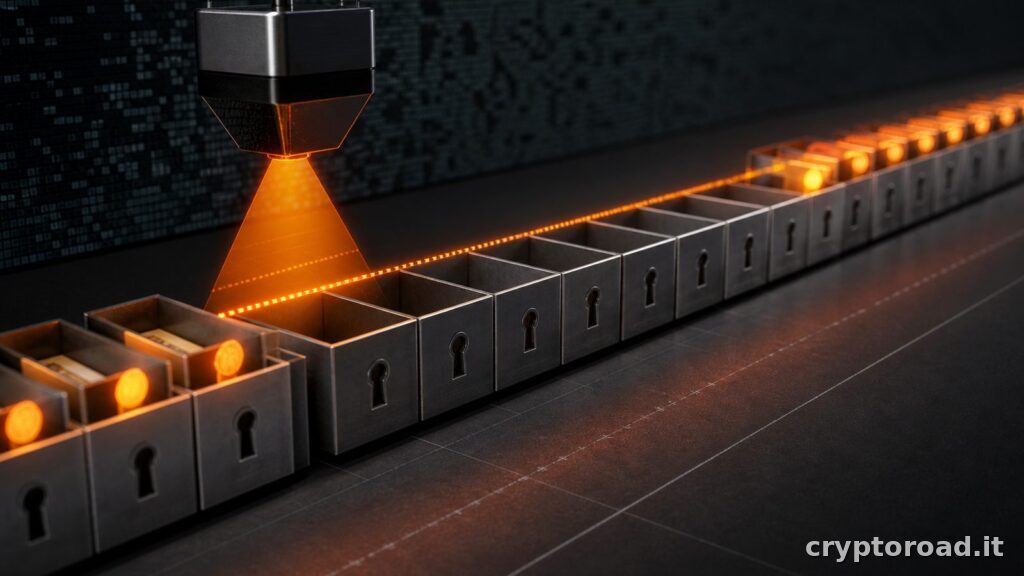
The Bitcoin gap limit is an address-discovery rule, not a cap on how much bitcoin you can own. A wallet may stop scanning before reaching an address that received a payment. The funds remain recorded on the blockchain; the application has not discovered them.
Why discovery stops
Deterministic wallets generate addresses in sequence. BIP44 describes stopping after twenty consecutive unused external addresses, but software policies vary. Transaction history matters, not only today’s balance: an address that received funds and was later emptied is different from one that has never been used.
The unpaid-invoice example
A merchant generates many invoice addresses that receive no payment. If the first paid invoice lies beyond the initial unused sequence, a limited recovery scan may miss it. Extending the correct range can reveal the payment. It neither creates coins nor requires the customer to pay again.
Further reading: related technical explainer.
Check the wallet configuration first
A wider range cannot correct a wrong passphrase, account or derivation path. Start with the original software and a known address. Check network, script type, account and branch before increasing scan depth. An address prefix alone does not identify the complete wallet configuration.
Further reading: connected operating guide.
Keep recovery secrets out of scanning services
Where supported, a watch-only setup using public data can help discover addresses without importing private keys into another service. Public extended keys still expose financial privacy. Descriptors may themselves contain private material, so do not share one without understanding exactly what it contains.
Further reading: security checklist.
Limits and records
A larger scan takes resources and cannot guarantee recovery from the wrong configuration. Do not change seed words experimentally or paste them into online checkers. Once the expected address is found, record the account, path, software and useful range. Consider moving funds only after establishing that you actually control them.
Generated is not the same as used
Displaying or printing an address does not make it used on the blockchain. Checkout systems may generate a fresh payment request for every attempt, so abandoned orders can create long unpaid sequences. Recovery settings need to reflect how addresses were generated rather than just the number of paying customers.
Make the check reproducible
Choose a known paid address and record the configuration expected to generate it. If a scan finds it, inspect history as well as the total balance. If it does not, the result still cannot distinguish an insufficient range from an incorrect setup. Change one parameter at a time so the effect remains understandable.
Do not hand control to a recovery service
Assistance should not turn address discovery into surrendering the wallet. Sharing an address has privacy implications; sharing seeds or private-key files changes the risk fundamentally. Keep the original backup intact and record each experiment. A documented process is more useful than repeatedly importing secrets into different apps.
Practical checks
- changing seed words to force a match.
- increasing the gap before confirming the path.
- forgetting the passphrase.
- using an online seed checker.
- scanning only receiving addresses and ignoring change.