Key takeaways
- The most underestimated risk is the mixing of personal and operational use.
- 2FA via app is generally preferable to SMS.
- SIM swap remains a concrete threat for account recovery and OTP.
- The best protection is procedural, not just technological.
Realistic threats on mobile
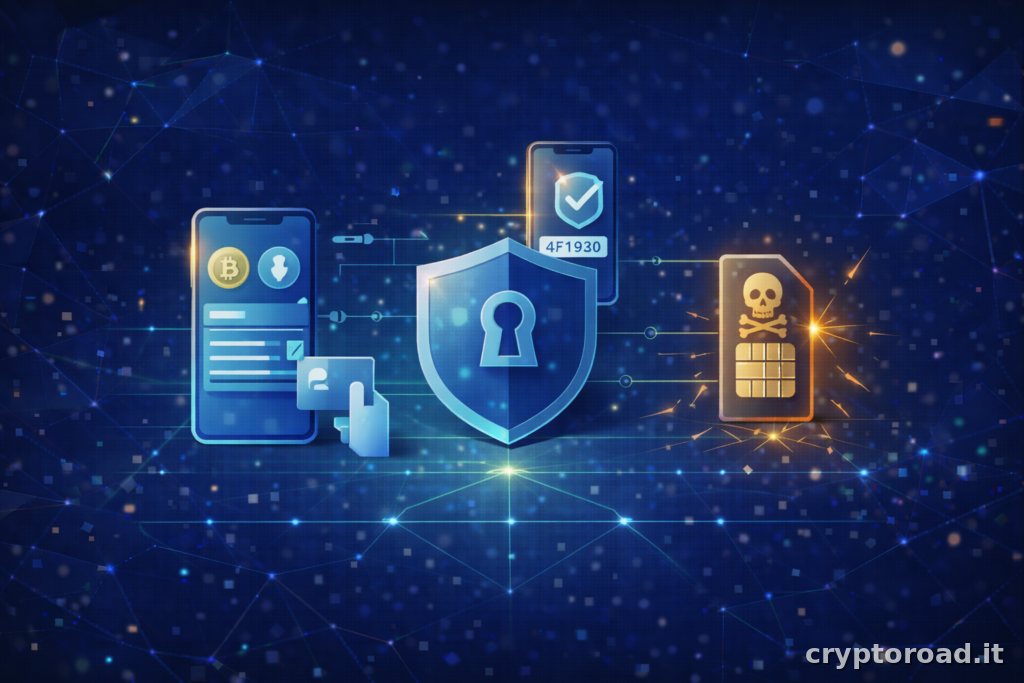
Targeted phishing, fake apps, remote access malware, and physical device theft are frequent scenarios. In many cases, the attack succeeds because the user confirms actions without verifying context and recipient.The basic rule is to reduce the attack surface: fewer sensitive apps, fewer permissions, fewer accounts with a significant impact on the same device.2FA: what works best
OTP apps and, when possible, hardware tokens offer a better profile than SMS. SMS remains vulnerable to interception and SIM swap.It is essential to keep offline recovery codes and periodically test the restore procedure.SIM swap: how to prevent it
Setting operator PINs, fraud prevention blocks, and additional checks on the phone profile reduces risk. It is also important to minimize dependence on the phone number for resetting critical accounts.In case of an unusual signal loss, treat the event immediately as a security incident.Recommended personal architecture
Separate the daily device from the operational device for high-value activities. Keep main wallets on dedicated hardware and use mobile wallets with exposure limits.This separation reduces the impact in case of compromise.First actions: distinguish the SIM, account and keys
Revision, September 6, 2026: emergency response has no guaranteed completion time and depends on what was compromised.
From a trusted device, contact your carrier if you suspect a SIM swap. For a compromised exchange account, use the service’s official channels for restrictions, sessions and recovery. These procedures differ from control of a self-custodial wallet’s keys.
If compromised keys and a sweeper bot are suspected, do not blindly add funds for gas. A new account derived from the same seed phrase does not resolve the compromise. Consult official instructions and never give your seed to purported recovery agents.
Conclusion
Mobile security is an ongoing process. With simple but rigorous rules, the risk is drastically reduced, even without complex tools.Mistakes to avoid
- Making decisions based on a single source or a single metric.
- Increasing exposure without a written exit plan and maximum risk limit.
- Confusing operational speed with the quality of execution.
Quick checklist
- Define the objective and risk limit before acting.
- Verify data, context, and critical dependencies.
- Execute in small steps, measure, then scale.
- Document the decision and result to improve the process.
FAQ
Is a mobile antivirus enough?
No, a comprehensive strategy is needed.Should SMS-2FA always be avoided?
When possible, yes, more robust methods are better.What is the first step today?
Separate critical accounts and activate SIM swap protection.Method and sources
To delve deeper, use official documentation from the protocols/entities involved, technical reports, verifiable on-chain data, and analysis with an explicit methodology. Avoid summaries without verifiable sources.Operational approach: from theory to practice
To transform mobile wallet security and SIM swap into useful decisions, a repeatable process is needed. The first step is to define the context: objective, time horizon, risk constraints, and the indicators you will use to evaluate whether the thesis is working or not. Without this perimeter, even good data is interpreted inconsistently.The second step is to set invalidation thresholds before taking action: what must happen to reduce exposure, suspend operations, or review the strategy. Predefined thresholds reduce impulsive errors and improve the quality of execution when the market accelerates.Practical cases and trade-offs
Every choice involves compromises. In mobile wallet security and SIM swap, the fastest solution does not always coincide with the most robust: reducing complexity can increase control, but sometimes limits flexibility. The goal is not to maximize a single metric, but to find a sustainable balance between efficiency, security, and liquidity.For this reason, it is useful to simulate two opposite scenarios: a base scenario and a stress scenario. In the first, you measure ordinary operating costs; in the second, you evaluate response times, execution quality, and the ability to contain damage. If the model does not hold up in a stress test, it must be corrected before increasing the scale.Decision-making framework in 5 steps
- Define the problem in a clear and verifiable sentence.
- Collect the minimum amount of reliable data, avoiding information overload.
- Evaluate alternatives with pros/cons and the maximum tolerable risk.
- Execute a controlled test with reduced exposure.
- Review the results and update operational rules/documentation.
Personal risk governance
An effective governance does not require complex structures: stable rules are enough. Define who can authorize changes to the strategy (even if you work alone), when to suspend operations, and what signals require extraordinary review. Formalizing these rules reduces the cost of errors.It is also useful to set up a weekly review with three questions: what worked, what didn’t work, and what to change immediately. The continuity of the review is worth more than a single perfect analysis.Advanced mistakes to avoid
- Confusing updated data with data useful for the specific problem.
- Increasing exposure only because the context seems favorable in the short term.
- Neglecting external dependencies such as counterparties and infrastructure.
Related reading: Bitcoin Market Cycles: The Complete Guide to Every Phase · On-chain analysis: a guide to understanding the crypto market.