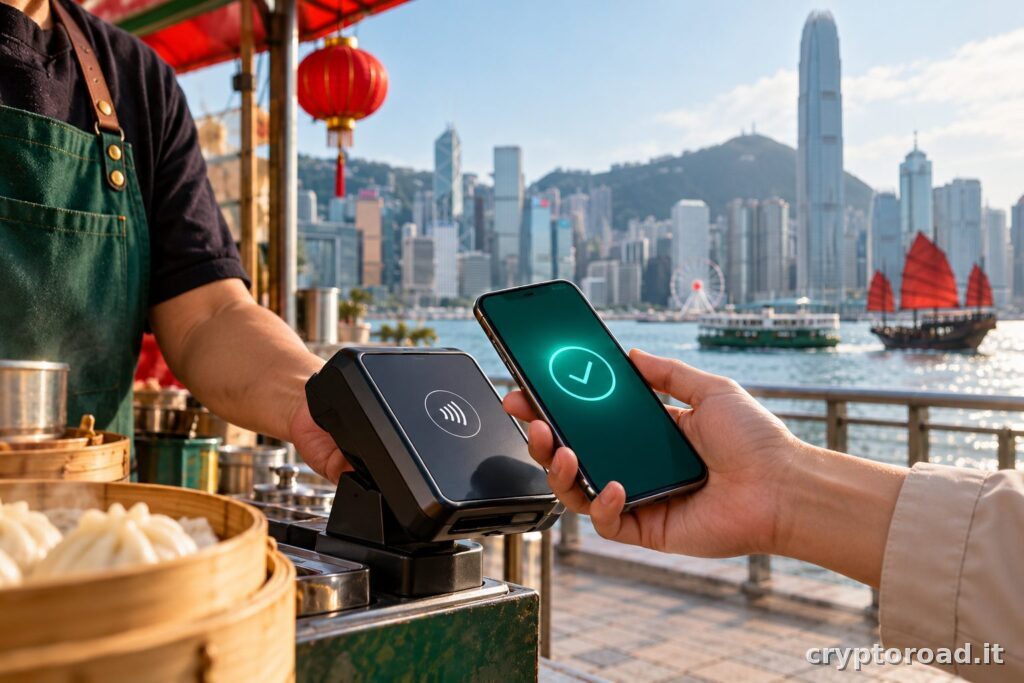
HSBC RedCoin began its PayMe rollout on October 23, 2026. The Hong Kong dollar stablecoin, identified by ticker RCHKD, puts tokenized payments inside an existing banking app. The useful question is not whether the name creates a trading opportunity, but how access, payment functions and the monetary reference fit together.
HSBC’s launch announcement describes wallet activation over the following days. PayMe’s existing customer base must therefore not be reported as the number of people already using the token. A large potential audience does not establish that every customer has activated a wallet or completed a payment.
HSBC RedCoin is denominated in Hong Kong dollars
The monetary reference is HKD, not the US dollar or the euro. For a European reader, that distinction comes before comparisons with familiar stablecoins. A balance denominated in Hong Kong dollars must be understood in that currency; tracking one reference does not remove exchange-rate considerations for someone measuring spending in another.
Our explanation of stablecoins and their risks offers background, but does not make individual products interchangeable. Issuers, terms, distribution and operating possibilities need checking for each service. Similar marketing vocabulary can describe substantially different customer experiences.
| Question | Distinction to retain |
|---|---|
| Monetary reference | Hong Kong dollar |
| Announced access | PayMe with phased wallet activation |
| Payments or investments? | Launch functions and subsequent plans are different stages |
| App users or token users? | Potential reach is not measured adoption |
A licence and a product launch are different milestones
HSBC announced its issuer licence in April. The regulatory framework can be checked through the HKMA issuer regime page. Authorization of an issuer and access to a specific function in a customer’s account are not the same fact.
This helps explain apparently conflicting coverage. A page written before launch may discuss a planned product, while a later update describes distribution already under way. Before treating a function as available, check the date, official channel and terms relevant to the account rather than combining statements from different periods.
The questions a payment user should ask
A practical assessment starts with simple steps: how a wallet is activated, which balance funds a payment, how the recipient is identified and what confirmation the app provides. A familiar interface can make the technology less intimidating without removing the need to understand the service.
Limits, support and conversion procedures also matter. Neither zero fees nor a particular reversal policy should be inferred merely from the word blockchain. The correct question is which rule the provider applies to that payment, through that channel, for that customer.
A merchant needs to understand reconciliation as well. The customer’s displayed balance, the accounting record and the availability of received funds are related but distinct matters. These checks should come before treating a new payment instrument as operationally identical to every existing method.
Keep current functions separate from the roadmap
A payment launch does not establish that every financial feature mentioned in a roadmap is live. Investment products require separate consideration of risks, eligibility and documentation. A token used to move value is not itself the fund unit that a future service might allow someone to buy.
Nor should unrestricted transfer to any wallet or DeFi application be assumed. Check supported networks, destinations and actual terms before sending money outside an official path. This article does not provide an unverified contract address as a shortcut for acquiring a banking product.
What early adoption figures would need to show
HSBC RedCoin should also be assessed after any introductory incentives end: a temporary discount does not demonstrate lower ordinary costs than the alternatives.
There are several different populations: customers who can see a feature, customers who activate it and customers who use it repeatedly. Distinguishing them makes the use case more understandable. An introductory promotion can encourage a trial without demonstrating a lasting consumer preference.
Consider two hypothetical customers. One activates a wallet for a discounted purchase and never returns; another uses it for recurring small payments. Both activations are real, but their implications differ. A combined account count says little about recurring usefulness without behavioral information.
Comparable observations over time would be more informative than attaching unreported volumes to the first press release. Our USDT and USDC comparison helps frame differences in access and distribution, not choose a universal winner between services with different audiences and rules.
How to follow the rollout without chasing imitation tokens
The official product and channel are more important than a familiar-looking name elsewhere. An unrelated trading listing or social message does not establish a connection to the bank. Users should verify the provider’s own instructions rather than trusting a ticker, screenshot or offer of early access.
For readers outside the intended market, the announcement should not be turned into an access tutorial that the available documentation does not support. Eligibility, app availability and specific functions must be confirmed separately. We have not independently opened an account or tested a RedCoin transaction.
The important development is the transition from a planned product to a payment rollout. What comes next should be judged by useful everyday transactions, understandable conditions and effective support, not by speculative excitement around launch. That is a more durable way to assess a bank-issued stablecoin.
