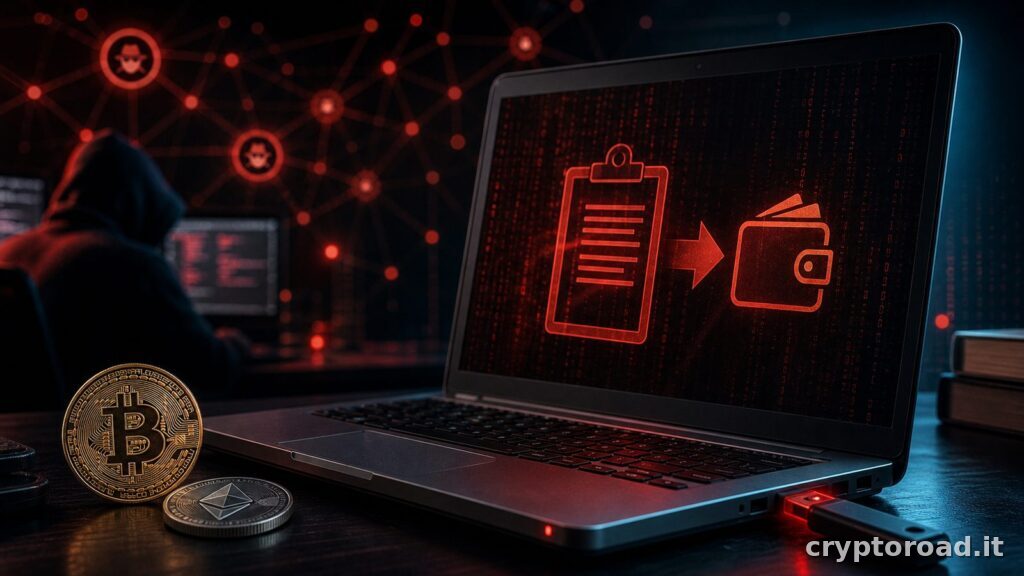
Updated June 19, 2026. Crypto clipper malware is back in focus because some campaigns target a habit many users treat as harmless: copying and pasting a wallet address before sending funds.
According to coverage published by CoinDesk on June 19, 2026, Microsoft identified malware able to collect sensitive data, replace crypto wallet addresses in the clipboard and spread through USB drives and modified shortcut files. The issue matters because a changed destination address can turn a routine crypto transfer into a permanent loss.
What crypto clipper malware does
A crypto clipper watches the operating system clipboard. When it sees a string that looks like a Bitcoin, Ethereum or other blockchain address, it can replace that string with an attacker-controlled address. The user copies the correct recipient, but the pasted destination is no longer the same.
This is dangerous because it exploits routine, not only a technical bug. People who move stablecoins, tokens or exchange balances often check the first few characters of an address and then move on. Attackers can use addresses that look similar enough at a glance, making the swap harder to notice under time pressure.
Why this crypto clipper case matters
The case matters for three reasons. First, the target is not one blockchain; it is the user workflow on a compromised device. Second, address replacement can affect people using legitimate wallets if the computer is already infected. Third, USB propagation turns the problem into an operational security issue, especially in environments where removable drives, archives or shortcut files are trusted too quickly.
Gridinsoft describes CryptoBandits as a Windows trojan with clipper behavior and a worm-like USB component. CoinDesk connected the case to Microsoft’s detection and to the risk of manipulated crypto wallet addresses. Microsoft has also analyzed malware families such as StilachiRAT, which focused on system reconnaissance, credentials and crypto-related browser or wallet data. The pattern is consistent: attackers do not need to break the chain when they can compromise the endpoint.
What users should check before sending crypto
The practical rule is simple: verify the address more than once before signing. Checking only the beginning of the string is not enough. Users should also compare the final characters, confirm the destination on a hardware wallet or official app screen, avoid blind copy-paste and pause when the device behaves strangely.
CryptoRoad’s send crypto safely checklist is directly relevant here. Small repeated checks are more useful than speed. For meaningful amounts, a test transfer may feel inefficient, but it is usually cheaper than an irreversible on-chain mistake.
Wallet security is not only about keys
Crypto clipper malware highlights an important distinction: a wallet protects keys, but it does not automatically secure everything happening on the computer. A non-custodial wallet, browser extension or desktop app can be legitimate and still be used on an infected device. That is why the choice between custodial, non-custodial, hot and cold wallets must be read together with endpoint security. The CryptoRoad guide to crypto wallets and custody models explains why key control needs operational discipline.
| Risk | Why it matters | Useful control |
| Address replacement | Funds go to the attacker | Check first and last characters |
| Compromised USB | Malware can spread through shortcuts | Avoid untrusted removable media |
| Clipboard manipulation | Copy-paste cannot be trusted | Compare on wallet/app screen |
| Irreversible transfer | There is no on-chain chargeback | Use test transfers for larger amounts |
For crypto companies, the risk is even more operational. Treasury teams, OTC desks, DeFi operators, market makers and smaller businesses moving stablecoins may have good written procedures but still fail if one endpoint used to prepare a transfer is compromised. Telling staff to “be careful” is not enough. Dedicated devices, restrictive USB policies, separation between browsing machines and signing machines, regular updates and multi-person approval for larger transfers matter more than generic security reminders.
Another mistake is treating clipper malware as a retail-only issue. The attack works because it inserts itself into a normal workflow. If an address is copied from a dashboard, an internal chat or an accounting file, the malware does not need to understand the business context. It only needs to wait for a compatible string and replace it. That simplicity makes crypto clipper malware persistent even when the market focuses more on smart contract exploits or bridge hacks.
The takeaway for crypto users
The point is not that every user is under immediate attack. The point is that risk expands as more people use wallets, exchanges, DeFi and stablecoins for regular operations. The most effective theft does not need to break Bitcoin or Ethereum; it only needs to change the destination at the wrong moment.
The takeaway is clear: crypto clipper malware turns a simple habit into a critical control point. Users should slow down, verify the whole address, protect the device and treat USB drives, attachments and shortcuts as potential risk surfaces. On-chain security often starts before the signature.
Sources: CoinDesk, Gridinsoft, Microsoft Security.