A wallet isn’t a bank account; it’s not a place where your cryptocurrencies “live.” Cryptocurrencies exist on the blockchain. A wallet manages the keys that allow you to authorize transactions. The difference between a good and a bad setup isn’t noticeable on calm days, but when something unexpected happens: lost phone, compromised PC, forgotten seed phrase, heirs who don’t know what to do.
What You’re Really Controlling: Private Keys, Seed Phrases, and Derivatives
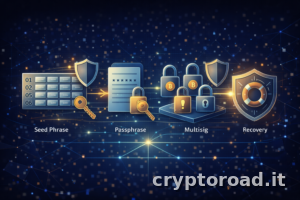
Most modern wallets use a seed phrase (12 or 24 words) from which keys are derived. This means two things:
- If someone obtains the seed, they can reconstruct the wallet and steal the funds.
- If you lose the seed (and don’t have a backup), you can permanently lose access.
The seed is therefore a “master key.” Treat it like you would your house keys and your bank account password, but with one difference: there’s no support to reset it.
Hot Wallet vs. Cold Wallet: Two Tools, Two Roles
Hot Wallet (software on phone or PC)
- Pros: Convenience, speed, ideal for daily operations (swaps, small payments, testing).
- Cons: Greater exposure to malware, phishing, malicious extensions, and “session hijacking.”
Cold Wallet (hardware wallet or air-gapped environment)
- Pros: Keys are isolated, reduced attack surface, suitable for large amounts of capital.
- Cons: Requires procedures and discipline: backups, recovery tests, updates.
Practical rule: hot wallet for small amounts, cold wallet for savings. Separating the roles is the simplest way to reduce errors.
Seed Phrase: Non-Negotiable Rules
- No screenshots, no photos, no cloud storage.
- No sending in chats “just to yourself.”
- Write it offline, with careful verification of each word and its order.
If you need a “backup,” it must be physical: high-quality paper or, even better, metal. Digital is convenient, but digital can also be copied without you realizing it.
Passphrase: The Hidden Wallet (and Its Risk)
Many wallets allow an additional passphrase: a password that creates a different set of keys compared to the seed phrase alone. This enables a very specific strategy:
- A main wallet protected by a passphrase.
- A “decoy” wallet without a passphrase with a small amount of cryptocurrency.
But a passphrase has a cost: if you forget it, there’s no recovery. If you use it, it must be stored separately from the seed phrase and tested before depositing significant amounts.
Serious Backups: Duplicates, Locations, and Tests
A “serious” backup isn’t just making ten copies. It’s making two well-thought-out copies, in two different locations, with a documented procedure (for yourself) and a recovery test.
- Copy A: at home, in a non-obvious and secure location.
- Copy B: in an external location (safety deposit box or trusted person with instructions).
Multisig: When It’s Really Worth It
Multisig (e.g., 2-of-3) requires multiple signatures to move funds. It’s great for large amounts of capital and shared management, but it adds complexity. The criterion is simple: if you can’t document and test the process, it’s probably better to use a single, well-configured cold wallet.
Final Checklist (Recommended Setup)
- Cold wallet for capital, with a strong PIN.
- Seed phrase on physical media + two copies in different locations.
- Passphrase only if you’re willing to manage it with the same seriousness as the seed phrase.
- Separate hot wallet for operations and testing.
- Recovery test before depositing significant amounts.
Conclusion
In 2026, technology will be simpler, but human errors will remain. A good wallet setup isn’t just about security; it’s about reducing stress and being able to react calmly when something happens.
Related reading: Bitcoin Market Cycles: The Complete Guide to Every Phase · On-chain analysis: a guide to understanding the crypto market.