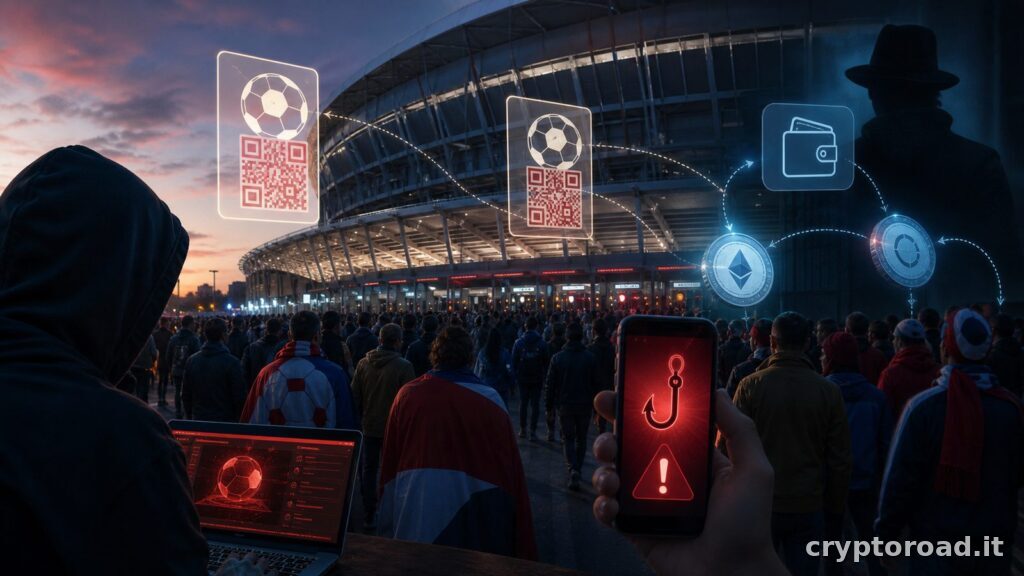
Updated June 13, 2026. World Cup crypto scams are becoming an operational security issue: fake tickets, fraudulent betting and wallet-to-wallet payments exploit global attention around the event.
According to Cointelegraph, TRM Labs warned about World Cup-related scams involving fake tickets, betting platforms and crypto payments designed to lure fans and less experienced users.
| Risk | How it appears |
| Fake tickets | Sites and QR codes that mimic official channels |
| Betting | Bonuses or odds used as bait |
| Wallets | Drainers and malicious signature requests |
The practical CryptoRoad point is clear: anyone buying tickets, merchandise or event services must treat each crypto payment as irreversible. Before signing, a solid crypto security guide is more useful than any discount.
Global events are ideal social-engineering terrain. They create urgency, scarcity, fear of missing a ticket and willingness to use unfamiliar payment channels. That is exactly the environment where phishing and wallet drainers perform well.
The risk is not limited to crypto-native users. A football fan who normally pays by card can be pushed toward stablecoins or wallets because a fake site promises a discount, priority queue or last-minute package.
The rule is simple: price is not enough. Users need to verify the domain, official channel, signature request, requested asset and destination address. Every opaque step increases risk.
World Cup crypto scams: why risk is rising
The Kraken FIFA crypto partnership showed how football is becoming a crypto adoption and marketing channel. The same visibility attracts fraud because millions of users search for tickets, apps, promos and fast payments at the same time.
Scammers use three levers: ticket scarcity, sports-brand authority and payment complexity. A polished site can look official even if it uses a fresh domain, a Telegram support channel and a destination wallet that cannot be verified.
That is why a checklist before sending crypto matters more than any commercial promise. If a transaction is irreversible, verification must happen before the click.
The most dangerous format is the small urgent payment. Users assume the loss is limited and lower their guard. But a payment can be followed by a malicious wallet signature, a second fee or an approval request.
Weak signals to watch
The first signal is urgency. Phrases like last availability, payment within minutes or exclusive access are useful to scammers because they prevent domain checks and external confirmation.
The second signal is a side channel. If the seller moves the conversation to private chat, DMs or a closed group, traceability is reduced. Official channels do not need wallet addresses manually sent in chat.
The third signal is a wallet signature. A site asking for broad approvals, indefinite permissions or interactions that are not needed for a ticket purchase should be treated as risky. Payment should not require access to user tokens.
After a suspicious interaction, users should check and, if needed, revoke crypto approvals. Closing the page is not enough when an allowance remains active.
What to do before paying
The minimum procedure is to use official channels only, type the domain manually, avoid unverified sponsored links and check that any payment wallet is published by a trusted source.
For larger amounts, a test transaction can help only after the recipient is verified and the asset type is correct. A test does not make a fake site safe; source verification comes first.
Wallet separation helps. A hot wallet with limited funds reduces damage compared with a primary wallet full of assets and approvals. Operational security matters more than habit.
Users should also distrust recovery promises. After a scam, new accounts may offer to recover funds for another fee. Often that is a second scam built on the first loss.
World Cup crypto scams are not theoretical. Global sport, digital payments and irreversible assets create a perfect environment for fast fraud. The defense is slow and concrete: verify first, sign less, keep wallets separated.
The best control remains the least elegant one: stop, open the official site from an independent search, compare domains and communications, then pay only when every element matches. Scams win when users follow the fastest link.
For community managers, pinned official messages and bans on user-posted wallet addresses help. Reducing information noise lowers the chance that fake support appears credible.
Another control is never to use the main wallet for event purchases, presales or time-limited campaigns. A separated wallet with limited funds reduces damage if a site asks for an unexpected signature or if the recipient turns out to be fake.
The strongest protection is the combination of technical caution and editorial common sense: no commercial urgency justifies an unreadable signature, a strange domain or a payment request delivered through private chat.
Users should also document the payment path before sending funds. Screenshots of the official page, transaction hash, support channel and exact destination address make later reporting easier, even when recovery is unlikely.
For exchanges and wallet providers, the opportunity is to build better warnings around event-driven scams. Clear risk labels, spender detection and address reputation checks can stop some mistakes before funds leave the wallet.
The final rule is deliberately conservative: if the purchase requires a new wallet connection, a broad token approval and a time pressure message, it should be treated as suspicious until independently verified.
To reduce scam exposure, the first layer is wallet structure: the crypto wallet guide explains why main funds, operational wallets and test wallets should stay separated.