Updated August 15, 2026.
Russia regulated crypto market rules are moving toward a September 1 start after the State Duma adopted the law governing cryptocurrency circulation. The change does not turn crypto into a domestic payment instrument. It builds a supervised route for trading, custody and related services through regulated intermediaries.
The Bank of Russia’s July 21 statement sets out two investor tracks. Non-qualified investors must pass a test and may buy the most liquid cryptocurrencies for no more than RUB 300,000 a year through each intermediary. Qualified investors must also pass the test, but face no amount limit.
Russia regulated crypto market: what the law says
Effective September 1, 2026, the law allows transactions through brokers, management companies and organised trading platforms. It also creates regulated crypto exchanges and digital depositories. Exchanges will buy and sell crypto; depositories will record rights in cryptocurrencies and digital rights.
The domestic-payment line remains firm. Crypto cannot be used to pay for goods or services inside Russia. Exporters and importers may, however, use cryptocurrencies in cross-border payments without limits. The central bank says those transactions may run through intermediaries or directly with any type of wallet and cryptocurrency.
That split makes this a market-infrastructure regime, not a general endorsement of token spending. For stablecoin users, regulated access does not remove the counterparty risk behind stablecoins: reserves, redemption and the service provider still matter.
Draft implementation rules are not the law
On July 27, the Bank of Russia said it had published its first draft regulations for regulatory impact assessment. They cover the trading framework and requirements for digital depositories. Those new participants must hold minimum equity of RUB 50 million to RUB 250 million, depending on activities such as working with open ledgers or providing post-trade settlement.
The required capital must consist of liquid assets, with financial assets of high credit quality. This matters because the launch will depend on who can safely custody assets, maintain records and settle transactions, not simply on which coins appear on a screen.
The law also gives market participants until July 1, 2027 to obtain licences and bring operations into line. September 1 is therefore the start of the legal framework, not proof that every venue will be licensed or offer every service on day one.
| Item | Status | Practical meaning |
|---|---|---|
| Law | Effective September 1, 2026 | Sets rules for circulation through intermediaries |
| Non-qualified retail | Test and RUB 300,000 yearly cap per intermediary | Limited access to the most liquid crypto |
| Qualified investors | Test required, no amount cap | No stated trading limit |
| Domestic payments | Prohibited | Crypto cannot pay for local purchases |
| Digital depositories | Draft rules under assessment | RUB 50m-250m equity requirement |
Bitcoin, Ether and USDT: a reported list, not a final rule
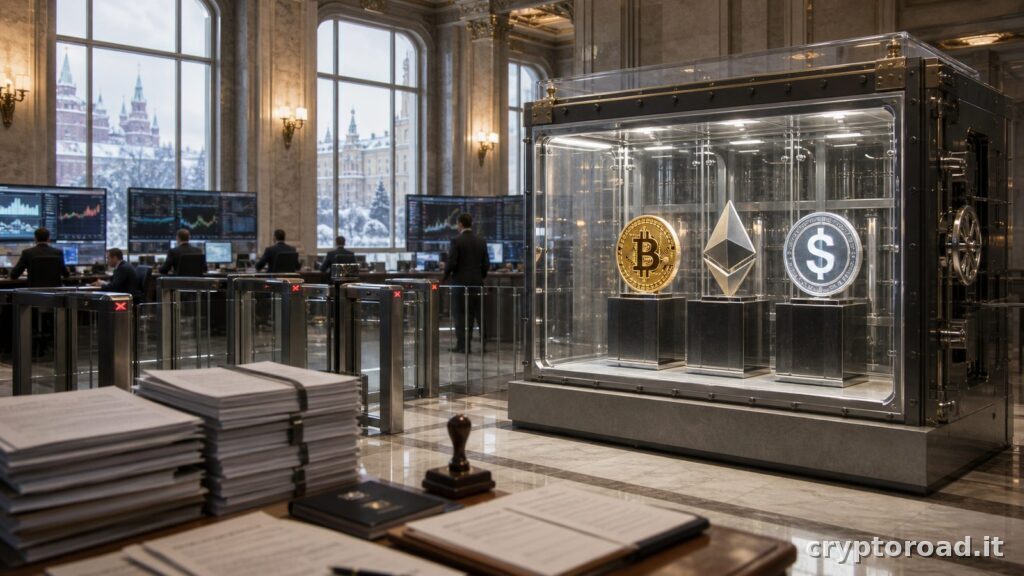
August 11 reporting on the draft framework said the initial retail list could be limited to Bitcoin, Ether and USDT. That distinction is crucial. The July 21 official announcement does not name a three-asset list, and the Bank of Russia has not presented it as a final adopted rule.
The official wording instead refers to “most liquid cryptocurrencies” and says the requirements will also apply to foreign stablecoins. BTC, ETH and USDT may describe a cautious starting point reported from the draft process; they do not yet establish a permanent entitlement to trade only those assets. Final rules and intermediary policies will decide the usable list.
What to watch before September
First, the market needs final regulations and admission criteria. Second, exchanges and depositories need to show they can meet licensing, capital and recordkeeping obligations. Third, retail clients need clarity on how the test will work in practice.
For international markets, the cross-border-payment permission may be as consequential as the retail cap. It can create regulated channels for foreign trade while leaving the domestic ban untouched. That differs from the stablecoin rules being discussed by the US and UK, but it reflects the same shift from broad rhetoric to market plumbing.
Bottom line: the Russia regulated crypto market has a law set to take effect on September 1; technical rules remain drafts; and BTC, ETH and USDT are a reported initial list, not a final official mandate.
Sources: Bank of Russia, July 21, 2026; Bank of Russia, July 27, 2026.